
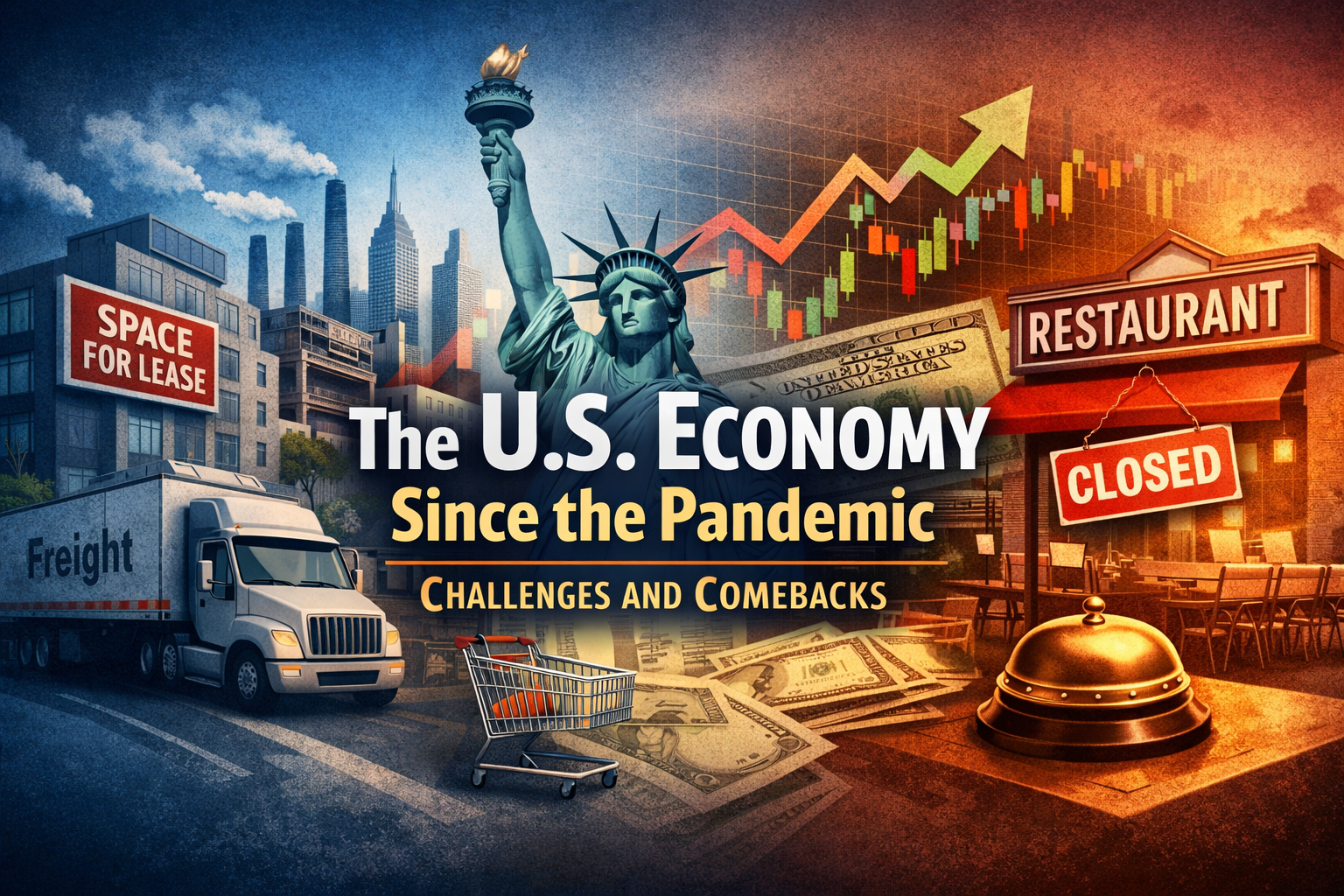
The post-pandemic U.S. economy isn’t a single story—it’s a bundle of mini-economies moving at different speeds. Some sectors are humming along. Others are still in a long, slow rebuild (or a quiet breakdown). And for small business owners, the practical truth is this: “The economy” is less important than your customers’ economy, plus your cost of money, labor, and demand predictability.
Here’s where things stand as of late 2025 into January 2026, which industries are still struggling, and how a few standout companies are winning anyway.
The Macro Snapshot: Cooling Inflation, Slower Hiring, Still-Growing GDP
Inflation has cooled substantially from the peak era. The U.S. CPI rose 2.7% year-over-year in December 2025 (core CPI 2.6%), according to the Bureau of Labor Statistics.
The job market is softer, not shattered. The BLS reported 4.4% unemployment in December 2025, with the rate and number of unemployed changing little that month.
Growth isn’t gone. The Bureau of Economic Analysis reported real GDP increased at a 4.3% annual rate in Q3 2025 (initial estimate), with consumer spending among the contributors.
Rates are lower than the peak, but financing still isn’t “cheap.” Reuters reporting in mid-January 2026 notes the Fed’s policy rate around 3.50%–3.75%, with officials signaling a deliberate approach.
What this means for SMBs: Customers are more price-sensitive, hiring is less forgiving, and any business model dependent on easy financing is still feeling the hangover.
Industries Still Struggling (and Why)
1) Office Real Estate: “It’s not dead—it’s divided.”
The office is still working through remote/hybrid reality and refinancing pressure. The pain is concentrated in older, non-prime buildings, while top-tier space is holding up better.
Cushman & Wakefield reported the national office vacancy rate finished Q4 2025 at 20.5%, with Class A vacancy slightly improving quarter-over-quarter—classic “flight to quality.”
CBRE similarly highlights how occupiers favor higher-quality space as demand rebounds slowly.
Why it’s still hard: high vacancies + tenant downsizing + expensive refinancing.
2) Freight & Trucking: A long “freight recession” squeeze
Freight demand has been choppy, and the industry has been digesting post-pandemic whiplash.
The Cass Freight Index reporting across 2025 reflects year-over-year shipment declines, with FreightWaves summarizing that 2025 shipments were down on average while expenditures held up better—implying rate/mix changes rather than broad volume strength.
Why it’s still hard: weak volumes + capacity imbalances + margin pressure.
3) Restaurants: Costs stayed high while traffic stayed moody
The sector is alive, but many operators are fighting a nasty equation: elevated operating costs + value-conscious customers + debt loads.
Nation’s Restaurant News reported 2025 filings outpaced 2024, with traffic and sales muted and input costs elevated.
NRN also framed 2025 as rough overall, with closures and restructurings—except for a small handful of brands executing well.
Why it’s still hard: labor + rent + food costs and customers trading down.
4) Manufacturing: Still in contraction territory
Manufacturing has been stuck in a soft patch. Reuters reported the ISM Manufacturing PMI fell to 47.9 in December 2025, marking another month of contraction (below 50).
ISM’s own roundup adds detail on weak employment and inventory dynamics.
Why it’s still hard: demand uncertainty + trade friction + inventory cycles.
5) Hospitality: A “two-speed” recovery with real headwinds
Hotels aren’t uniformly struggling—some are doing well—but the sector is dealing with slower growth, margin pressure, and uneven demand.
PwC’s U.S. Hospitality Directions outlook anticipates RevPAR headwinds in the first half of 2026, with moderate acceleration expected later as large-scale events and macro stability support business and inbound travel.
CBRE also reduced its U.S. 2025 RevPAR growth forecast in its global hotel outlook, reflecting softer conditions.
Meanwhile, Reuters reported foreign visitors to the U.S. fell 6% in 2025 (and spending by foreign tourists also fell), which hits gateway markets and tourism-dependent operators harder.
Why it’s still hard: softer inbound travel + high labor costs + competition from alternatives + demand fragmentation.
6) Event Services: Demand is back—profitability is the fight
Live events have regained importance, but the cost structure has teeth.
A Cendyn “State of the Meetings Industry” planner survey notes planners’ dissatisfaction with rising costs and budget strain.
Freeman’s trends commentary underscores that retention/repeat attendance is a major pressure point, pushing organizers to redesign experiences that actually earn a return visit.
Why it’s still hard: vendor/venue cost inflation + attendee acquisition costs + retention challenges.
Case Studies: Winners in Struggling (or Choppy) Industries
Case Study 1: Old Dominion Freight Line (Freight)
How they’re winning: treat the downturn like an efficiency competition.
Reuters reported Old Dominion beat Q3 profit expectations in late 2025, helped by tight expense control during a prolonged freight recession.
In its Q3 2025 release, Old Dominion emphasized operational efficiency and keeping direct operating expenses steady as a share of revenue, even as revenue declined.
What they do that others don’t:
- Relentless cost control without collapsing service
- Process discipline (small inefficiencies become fatal when volumes are soft)
- Execution consistency instead of “wait it out” leadership
SMB steal: If you don’t know your margins by customer type and channel every week, you’re not managing—you’re guessing.
Case Study 2: TJX (Retail)
How they’re winning: make value a system, not a coupon.
Reuters reported TJX raised its annual profit forecast, driven by demand from consumers seeking value; it also pointed to TJX’s flexible sourcing as a key advantage.
What they do that others don’t:
- Agile inventory (buy smart, move fast)
- A clear value promise without constant margin-killing promotions
- A repeatable “treasure hunt” experience that drives traffic
SMB steal: “Value” can mean pricing, yes—but it can also mean speed, certainty, bundled offers, guarantees, and convenience.
Case Study 3: Chipotle (Restaurants)
How they’re winning: build convenience into the operating model.
Chipotle’s Q2 2025 release reported digital sales were 35.5% of total food & beverage revenue and noted new openings frequently include “Chipotlanes,” which the company says boost sales, margins, and returns.
What they do that others don’t:
- Digital is operations, not just marketing
- Throughput and access are designed in (pickup lanes, workflow)
- Convenience becomes a moat
SMB steal: Stop relying on walk-ins and “someone will call back.” Build systems that capture demand automatically and move it to a booked next step.
Case Study 4: Hilton (Hospitality)
How they’re winning: loyalty + direct booking + operational tech leverage.
Hilton’s Q3 2025 earnings release highlights its Hilton Honors ecosystem (with very large membership) and the app experience—booking, room selection, check-in, Digital Key, and checkout via smartphone.
What they do that others don’t:
- Own the customer relationship (loyalty and direct channels)
- Reduce friction at every step (which supports repeat behavior)
- Use tech to improve operations, not just brand shine
SMB steal: Reduce “friction tax.” Every delayed reply, missed call, or confusing booking step is you paying interest on lost revenue.
Case Study 5: Marriott (Hospitality)
How they’re winning: portfolio breadth + disciplined performance management across markets.
Marriott reported Q3 2025 RevPAR up 0.5% worldwide, with stronger growth internationally and a slight decline in U.S. & Canada—showing the unevenness by region and segment.
What they do that others don’t:
- Segment and region diversity to absorb demand shifts
- Scale-driven discipline in distribution and revenue management
- Operational standardization that protects margins
SMB steal: Segment your pipeline like your life depends on it—because it does. One-size-fits-all messaging is expensive in a choppy market.
Case Study 6: Informa (Event Services / B2B Events)
How they’re winning: turn events into a product + data engine.
TSNN reported strong growth indicators for major organizers like Informa and RELX in 2025, with momentum projected into 2026.
The Wall Street Journal reported Informa’s CEO is betting on AI to accelerate growth—using internal AI for product development, event curation, and marketing, and monetizing content assets.
What they do that others don’t:
- Productize the event (repeatable formats, scalable playbooks)
- Use the data layer (segmentation, matchmaking, sponsor ROI proof)
- Apply AI to operations and go-to-market, not just content
SMB steal: If your business still lives in spreadsheets and inbox archaeology, you’ll lose to someone who runs a pipeline like a machine.
The Common Thread: Winners Reduce Randomness
Across these industries, the outperformers do four things consistently:
- They run tighter operations than competitors.
- They sell certainty in uncertain times (value, speed, reliability, convenience).
- They use data as a steering wheel, not a rearview mirror.
- They automate the boring parts so humans can sell, serve, and retain.
The BetterBiz Play: A “Choppy Economy” Operating System for SMBs
If your industry is under pressure (hospitality, events, restaurants, freight-adjacent services), you don’t need more motivational quotes. You need speed, follow-up, and visibility:
- Capture every lead (calls, forms, DMs, inbox) into one CRM
- Instant response with an AI voice agent (qualify, route, book)
- Automated reactivation for old leads and past customers
- Pipeline clarity (who’s stuck, why deals are lost, what to fix this week)
- Owner notifications that are actionable (“VIP calling” vs “unknown prospect—needs qualification”)
That’s the boring stuff that builds non-boring revenue. If you would like to discuss streamlining your business, visit betterbizgroup.com, or email us at info@betterbizgroup.com.
