
Small businesses don’t have a marketing problem—they have a stack problem.
Too many tools. Too many dashboards. Too many subscriptions doing overlapping jobs. Somewhere along the way, “more tech” became confused with “better marketing.”
The truth is simpler.
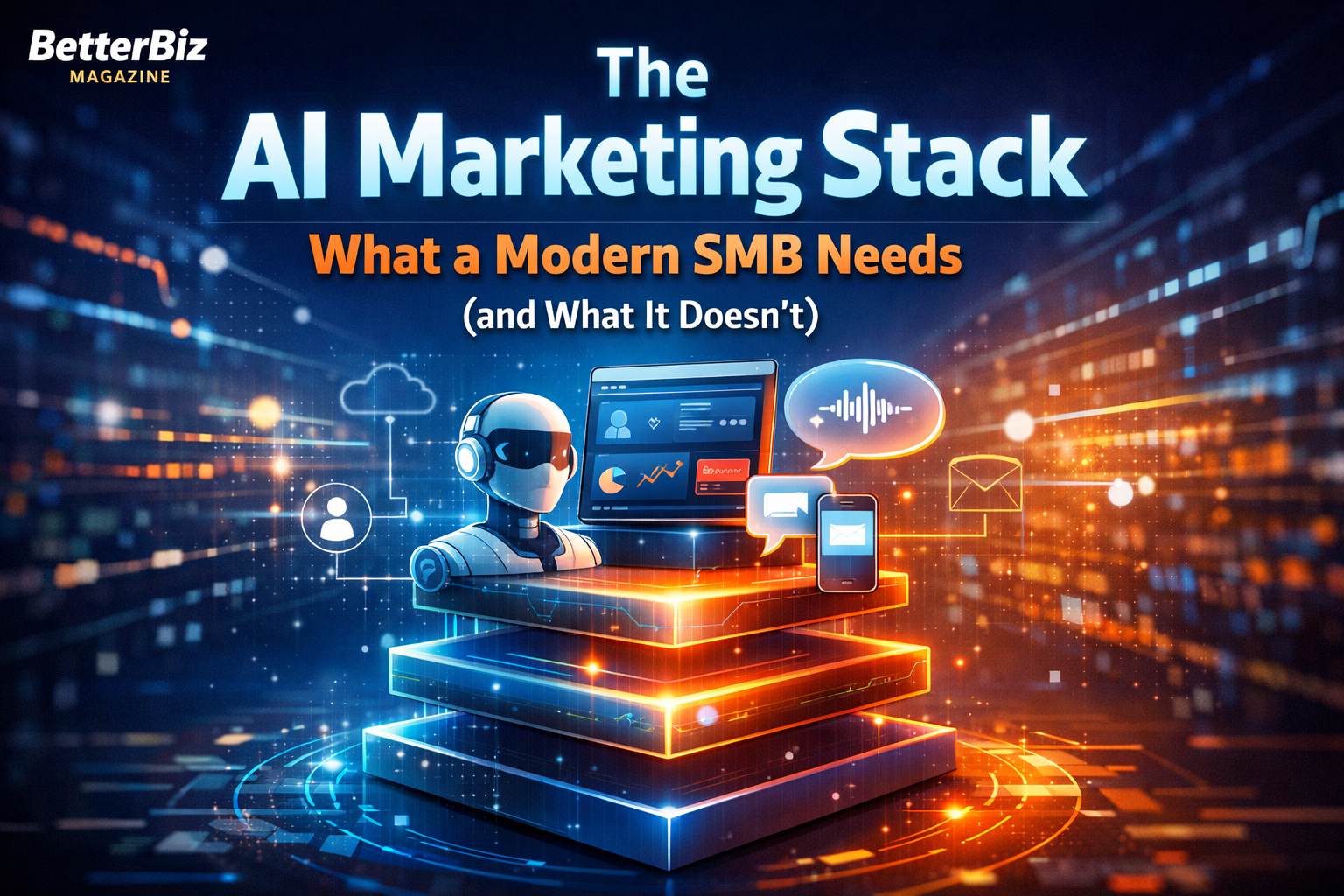
A modern SMB doesn’t need an enterprise-sized marketing stack. It needs a lean, integrated AI marketing stack that automates friction, captures opportunity, and scales without chaos.
Here’s what today’s small and midsize businesses actually need—and what they can confidently leave behind.
The Goal of an AI Marketing Stack (It’s Not More Software)
According to McKinsey, companies that succeed with AI focus on workflow impact, not tool count. The biggest gains come when AI improves speed, consistency, and decision-making across everyday processes—not when it adds another login.
For SMBs, the goal of an AI marketing stack is to:
- Respond to leads instantly
- Automate follow-up across channels
- Reduce repetitive manual work
- Create a single view of the customer
Anything that doesn’t support those outcomes is unnecessary noise.
What a Modern SMB Does Need
1. A CRM That Actually Runs the Business
Your CRM should be the brain of your operation—not just a contact database.
A modern CRM needs to:
- Track every interaction (calls, emails, SMS, forms)
- Trigger automations automatically
- Sync marketing, sales, and service activity in one place
This is where platforms like BetterBiz CRM come into play. Rather than acting as passive storage, BetterBiz CRM is designed to orchestrate action—connecting lead capture, communication, automation, and reporting into a single system of record.
Salesforce and HubSpot both emphasize that high-performing companies treat CRM as revenue infrastructure. SMBs benefit most when that infrastructure is simple, connected, and affordable.
2. AI-Powered Marketing Automation (Not Just Email Campaigns)
Traditional automation schedules messages. AI-powered automation makes decisions.
The right automation layer should:
- Prioritize and route leads automatically
- Trigger follow-ups based on behavior, not guesswork
- Coordinate actions across email, SMS, voice, and CRM
With BetterBiz CRM, automation is built around real workflows—what happens when a lead submits a form, misses a call, books a meeting, or goes quiet. Paired with BetterBiz AI Agents, those workflows can respond instantly, without human intervention.
Forrester notes that automation delivers the highest ROI when it orchestrates full customer journeys, not isolated campaigns.
3. Conversational AI and Voice Bots That Work Together
This is where many SMB stacks fall short.
Modern buyers expect immediate responses. AI voice bots and chat agents can:
- Answer inbound calls 24/7
- Qualify leads in real time
- Create or update CRM records automatically
- Trigger follow-up via email or SMS
BetterBiz AI Agents are designed to sit at the front of this process—handling calls, capturing intent, and pushing structured data directly into BetterBiz CRM so nothing is lost or forgotten.
According to Gartner, conversational AI is becoming the primary entry point for customer engagement, especially for organizations without large sales or service teams.
For SMBs, voice bots aren’t about replacing people. They’re about ensuring no opportunity is missed when people aren’t available.
4. Email and SMS as a Unified System
Email and SMS should never operate in silos.
A modern AI marketing stack uses them together to:
- Confirm actions instantly
- Send reminders and updates automatically
- Escalate when responses stall
Within BetterBiz CRM, email and SMS are triggered by real-time events—calls completed, tickets created, appointments booked—creating consistent, timely communication without manual effort.
Twilio’s State of Customer Engagement Report shows customers are far more likely to engage when businesses use coordinated, multi-channel messaging instead of relying on a single channel.
5. Analytics That Drive Action, Not Just Reports
Dashboards alone don’t improve performance. Decisions do.
AI-enhanced analytics help SMBs:
- Identify which leads are most likely to convert
- Spot bottlenecks in the funnel
- Optimize follow-up timing and messaging
Because BetterBiz CRM centralizes voice, email, SMS, and automation data, insights are generated from actual behavior, not disconnected reports.
PwC notes that intelligent analytics improves both operational efficiency and executive decision-making—especially in lean organizations.
What a Modern SMB Doesn’t Need
1. Tool Sprawl
If you’re using separate platforms for:
- Forms
- Scheduling
- SMS
- Call tracking
…you’re likely creating more manual work than automation.
Disconnected tools create gaps. Gaps create missed revenue.
2. Enterprise Software You’ll Never Fully Use
Many SMBs buy enterprise platforms hoping to “grow into them.”
Most never do.
Gartner consistently reports that underutilized features are one of the biggest hidden costs in marketing technology.
A smaller, integrated stack—like BetterBiz CRM paired with AI Agents—often delivers more value than a bloated enterprise platform.
3. AI Tools That Don’t Integrate
An AI tool that doesn’t connect to your CRM or automation workflows is a novelty—not a strategy.
If it can’t trigger actions or learn from real data, it won’t scale.
The Stack That Wins: Lean, Integrated, Intelligent
The most effective AI marketing stacks share three traits:
- Fewer tools, tighter integration
- Automation across the full lifecycle, not just lead gen
- AI embedded into workflows, not bolted on
This is exactly where SMBs can outperform larger competitors. Without legacy systems or excessive tech debt, they can deploy smarter systems faster.
Final Thought
The future of SMB marketing isn’t about chasing every new AI tool.
It’s about building a cohesive system where:
- Every lead is captured
- Every interaction is logged
- Every follow-up happens automatically
- Every decision is data-informed
With platforms like BetterBiz CRM and BetterBiz AI Agents, that system becomes achievable—without complexity or enterprise-level cost.
A modern AI marketing stack doesn’t feel complicated.
It feels invisible—because it works.
Sources
- McKinsey & Company, The Economic Potential of Generative AI
- Gartner, Marketing Technology and Conversational AI Forecasts
- Forrester, Marketing Automation and Revenue Operations Research
- PwC, AI-Powered Analytics and Decision-Making
- Twilio, State of Customer Engagement Report