
B2B event sponsorship can generate qualified conversations, valuable content, and a measurable pipeline. But only when sponsors treat the event as a campaign, not a two-day appearance.
Companies invest heavily in events because face-to-face conversations can accomplish something difficult to replicate through advertising alone: putting sellers, subject-matter experts, and buyers in the same room.
However, sponsors are under increasing pressure to demonstrate more than attendance, badge scans, and logo visibility. Sponsors now expect access to the right audiences, structured opportunities for interaction, credible engagement data, and a connection between event activity and business outcomes.
The good news is that a sponsorship can continue producing value long after the exhibit hall closes. A presentation can become months of marketing content. A question asked during a session can open the door to a relevant sales conversation. A ten-minute booth discussion can become a qualified opportunity, provided someone records what was actually discussed.
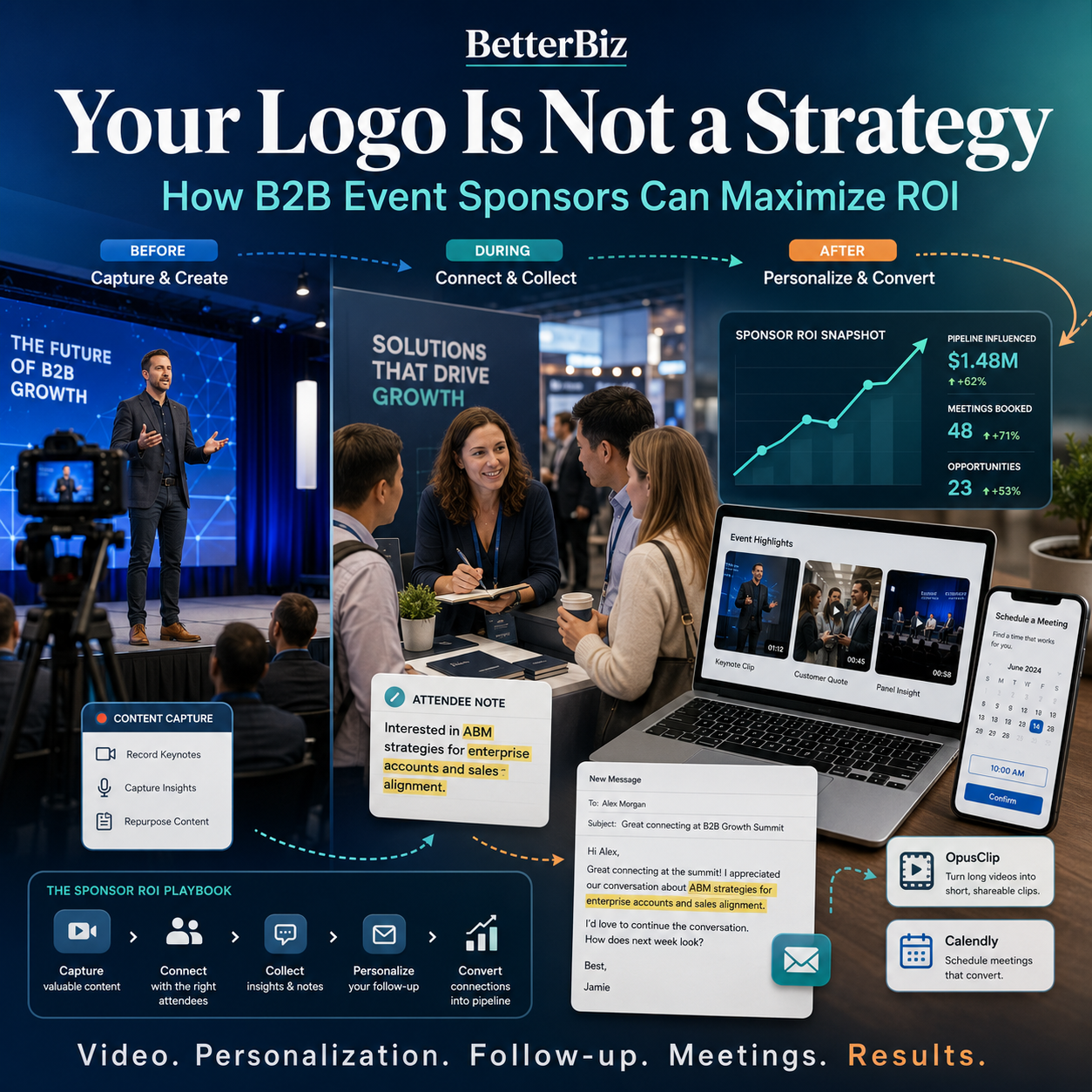
The key is to approach sponsorship as a coordinated revenue and content campaign with three phases: before, during, and after the event.
Start with the business objective, not the sponsorship package
Sponsors often begin by comparing benefits:
- How many passes are included?
- Is there a speaking opportunity?
- How large is the exhibit space?
- Where will the logo appear?
Those details matter, but they do not constitute a strategy.
Before selecting a package, determine what the company needs the event to accomplish. The objective may be to generate new sales opportunities, accelerate existing accounts, introduce a product, establish thought leadership or develop relationships within a specific market.
Each objective requires a different activation.
A company launching a technology platform may benefit from a demonstration or sponsored session. A consulting firm may receive more value from an executive roundtable. A company targeting a small group of enterprise buyers may be better served by five scheduled meetings than 500 booth visitors.
Set measurable goals before committing the budget. Those goals might include:
- Ten meetings with target accounts
- Twenty-five qualified leads
- Three opportunities added to the pipeline
- Five executive-level follow-up meetings
- Eight pieces of reusable video content
- Engagement from a defined list of existing prospects
This makes it possible to evaluate the sponsorship against business outcomes instead of booth traffic and branded merchandise distribution.
A lean-team sponsorship story
Imagine a three-person marketing team at a workforce technology company sponsoring a two-day HR conference.
The company has purchased a tabletop, two passes, and a 20-minute presentation. It does not have a video department, a large demand-generation team, or an agency traveling to the event.
Its objective is to generate ten qualified conversations and four post-event demonstrations with employers that have more than 1,000 employees.
Here is how that small team could execute.
Two weeks before the event, the team creates a list of 25 target organizations expected to attend. Sales representatives contact existing prospects with personal invitations to the presentation. Rather than sending a generic blast, each invitation explains why the session may be relevant to that particular company.
One person is assigned to speak and meet prospects. A second manages the tabletop and captures detailed lead information. The third attends conference sessions, takes notes and listens for comments related to the problems the company solves.
After the presentation, the team uploads the video to OpusClip, creates several short clips, adds captions and schedules the clips for distribution. OpusClip is designed to turn long-form video into shorter social content and can automatically identify highlights, reframe videos and add captions.
Every qualified prospect receives a personal follow-up message with a Calendly link for the appropriate type of conversation. The company can use different links for product demonstrations, executive consultations and short introductory calls instead of sending everyone to the same calendar.
Within a week, the company has converted one presentation into a social campaign, followed up with its best prospects and created a clear path from the conference conversation to a scheduled sales meeting.
That is event activation. Standing behind a table and hoping someone asks for a brochure is event attendance.
Turn the speaking opportunity into a content engine
A sponsored presentation should not disappear the moment the speaker leaves the stage.
If the sponsorship includes a session, keynote, panel or demonstration, arrange to have it professionally recorded. Confirm recording rights with the organizer before the event and determine what files will be delivered afterward.
Ask whether the sponsor will receive:
- The full recording
- Separate speaker footage
- Edited highlights
- Raw video files
- Presentation slides
- Captions or a transcript
- Permission to use attendee questions
Do not wait until the speaker walks onstage to discover that nobody pressed record.
Cvent has profiled event marketers who repurpose interviews, podcasts and other footage captured during a two-day event into content that can be distributed for months.
The presentation can become:
- An on-demand webinar
- LinkedIn video clips
- Email campaign content
- Sales enablement videos
- Blog articles
- Quote graphics
- Podcast segments
- Website videos
- Account-based marketing content
Use OpusClip to reduce editing time
A smaller marketing team does not need to manually watch an entire 30-minute presentation ten times looking for usable moments.
Upload the recording to OpusClip and ask the platform to identify potential short-form clips. It can create shorter videos, add captions, reframe the speaker for vertical platforms and prepare content for social distribution.
A human should still review every clip. AI may identify the most dramatic sentence without understanding whether that sentence makes sense outside the full presentation.
The best approach is to plan for clips before the event. The speaker should build several clean, self-contained observations into the presentation, such as:
“The biggest mistake organizations make when implementing AI is treating adoption as a technology problem instead of a workforce problem.”
That statement can become a LinkedIn clip, an email introduction, a blog headline or the opening of a sales conversation.
One speaking slot should produce more than applause. It should produce an inventory of marketable ideas.
Use Canva to keep the content consistent
Canva can help a small team create branded thumbnails, quote graphics, email images and social posts without routing every asset through a graphic designer.
Canva’s Content Planner also allows teams to organize and schedule posts across platforms including LinkedIn. Its video tools can resize content for different social formats and apply brand elements consistently.
Create a small set of templates before the conference:
- Speaker quote graphic
- Video clip cover
- Key event takeaway
- Customer problem and solution
- Post-event webinar promotion
After the event, the marketing team only needs to replace the text, photograph or clip. That is considerably faster than designing every post from scratch.
Attend the sessions instead of guarding the booth all day
One of the most underused event intelligence tools is also the simplest: listening.
Sponsors frequently send several employees to an event, only to position every one of them at the booth. Meanwhile, attendees are describing their priorities, frustrations and planned investments in conference sessions a few rooms away.
Assign at least one member of the sponsorship team to attend sessions. That person should keep structured notes on:
- Questions asked by attendees
- Challenges mentioned during discussions
- Technologies attendees are evaluating
- Objections raised about existing solutions
- Projects attendees expect to launch
- Language attendees use to describe their problems
- Comments made by target accounts or existing prospects
The purpose is not to create a conference surveillance operation. Do not record private conversations, and follow the organizer’s rules regarding session recording. The goal is to understand the market and follow up with relevance.
A simple shared document or mobile form can make the notes immediately available to the sales team. Useful fields might include:
- Attendee name
- Company
- Session
- Comment or question
- Related business challenge
- Relevant company solution
- Recommended follow-up
- Assigned salesperson
This turns observations into usable sales intelligence rather than a notebook that remains buried in someone’s conference bag.
Personalization is the difference between follow-up and spam
Suppose a vice president of talent acquisition comments during a session that her organization has purchased several recruiting technologies but struggles to get hiring managers to use them consistently.
A generic follow-up might say:
It was great meeting you at the conference. Would you have 30 minutes to learn more about our platform?
A personalized message would say:
Your comment during the talent technology session about hiring-manager adoption stayed with me. Many organizations focus heavily on selecting the platform but underestimate the workflow and change-management side of implementation. Our approach includes manager-specific adoption reporting and automated reminders, which may help address the gap you described. I would be glad to show you how another employer structured its rollout.
The second message proves that the sender listened. It connects the attendee’s own observation to a relevant business problem and explains why continuing the conversation may be worthwhile.
LinkedIn defines meaningful B2B personalization as demonstrating an understanding of the prospect’s business context, priorities and strategic initiatives, not merely inserting a name, title or company into a template. LinkedIn has also reported that sellers using AI to help create personalized outreach experienced an average 28% increase in buyer response rates.
AI can help organize session notes or prepare a first draft. It should not erase the human observation that makes the message personal.
The formula is simple:
What I heard + why it matters + how we may help + an easy next step
Make it easy to schedule the next conversation
A promising event discussion can die during the email exchange that follows:
Are you available Tuesday?
Tuesday is difficult. What about Thursday?
Thursday works in the afternoon.
I am traveling Thursday afternoon.
Reduce that friction by including a Calendly link in the follow-up.
Calendly can be used to qualify prospects, route them to the right representative and allow them to select a meeting time immediately. Its routing tools can direct different types of prospects to different scheduling pages based on information such as industry, company size or stated need.
Do not simply paste a naked scheduling link beneath a generic email.
Personalize the reason for the meeting first:
Based on your comments about manager adoption, I believe a 20-minute conversation focused on implementation reporting would be most useful. Here is my calendar so you can select a convenient time.
Create event-specific scheduling options such as:
- 15-minute conference follow-up
- 30-minute product demonstration
- Executive consultation
- Technical discussion
- Partnership conversation
The scheduling tool reduces administrative work. The personalized message gives the recipient a reason to use it.
Capture context, not just contact information
A badge scan identifies a person. It does not explain why that person stopped.
Every lead record should contain enough information for someone who was not at the event to understand the interaction.
Record:
- The person’s primary challenge
- The solution or service discussed
- Level of interest
- Decision-making role
- Current provider or process
- Expected timing
- Agreed next step
- Team member responsible for follow-up
- Relevant personal or session context
Event lead-capture tools can allow sponsors to scan badges, rate leads, add custom qualification information and export records for follow-up. Cvent, for example, allows exhibitors and sponsors to add notes and custom questions while qualifying leads onsite.
A company does not necessarily need an enterprise system for a small event. A well-designed mobile form connected to a spreadsheet or CRM may be sufficient, provided every team member uses it consistently.
“Interested in analytics” is not a useful note.
“Needs to combine workforce data from four systems before Q1 planning; requested an analytics demonstration in August” gives the sales team something it can act on.
Use the tools you already have
Sponsors sometimes create unnecessary work by buying a new platform for every stage of the event.
A lean sponsorship stack may include:
| Need | Lean tool or approach | Practical use |
|---|---|---|
| Video repurposing | OpusClip | Convert a presentation into captioned social clips |
| Graphics and scheduling | Canva | Create branded graphics and schedule content |
| Meeting booking | Calendly | Let qualified prospects schedule the appropriate follow-up |
| Lead capture | Organizer’s app or a simple mobile form | Record contact details, interests and conversation notes |
| Follow-up | Existing CRM or email platform | Segment leads and send personalized outreach |
| Team notes | Shared document or form | Capture comments heard during sessions |
| Reporting | CRM campaign or spreadsheet | Track meetings, opportunities and revenue |
The objective is not to assemble the largest technology stack. It is to eliminate repetitive work while preserving personal relevance.
Automation should handle cropping videos, scheduling posts, routing meetings and moving data.
People should handle listening, judgment, relationship building and the final review of personalized messages.
Follow up in layers, not with one mass email
Event follow-up should begin quickly, but speed does not require sameness.
Divide contacts into practical groups.
Priority prospects
These are people with an active project, defined need or agreed next step. Send an individual message from the person who spoke with them. Reference the conversation and include the appropriate Calendly link.
Target accounts
These are organizations the sponsor wants to develop, even if there is no immediate project. Reference a session, business priority or relevant event theme. Offer a useful clip, article or benchmark rather than pushing directly for a sales demonstration.
Presentation attendees
Send the recording, slides or a related resource. Whenever possible, personalize the message based on the question the person asked or the topic that appeared most relevant.
General leads
Place contacts with limited qualification information into a broader event nurture campaign. Do not pretend every badge scan represents an immediate sales opportunity.
The first email should continue the conversation, not restart it.
Cvent’s 6sense case study emphasizes the importance of richer event data, faster response and more personalized follow-up in turning event investments into repeatable revenue outcomes.
Build a month of marketing from the event
The strongest sponsorship campaigns keep working after the venue begins stacking chairs.
A practical post-event content schedule could look like this:
Within 48 hours
Send personalized follow-up messages to priority prospects. Publish a thank-you post and share one strong photograph or quote from the presentation.
During the first week
Release the first OpusClip video, send the full recording to presentation attendees and publish an article based on a major event discussion.
During the second week
Share a second clip that addresses a different buyer concern. Send it personally to prospects who discussed that issue.
During the third week
Publish an attendee takeaway, executive commentary or customer example connected to the presentation.
During the fourth week
Host a virtual follow-up discussion or demonstration. Use Calendly to offer individual meetings to prospects who are not ready for a group session.
Content should also be personalized by audience when possible. A chief human resources officer may care about business impact and risk. A talent acquisition leader may care about recruiter productivity and candidate experience. An HR technology leader may care about integration, governance and implementation.
The underlying video can be the same. The headline, introductory message and call to action should reflect the person receiving it.
A real-world lesson: Connect the data to sales activity
Merkle provides a useful example of moving beyond disconnected spreadsheets and manual event processes.
The company integrated its event platform with Salesforce and marketing automation tools, allowing registration and engagement information to flow into systems used by sales and marketing. That structure helped the company segment attendees and customize communications based on factors such as industry, title and engagement.
The lesson for smaller sponsors is not that every company needs an enterprise technology implementation.
The lesson is that every piece of event activity should lead somewhere:
- The presentation creates content.
- The content creates engagement.
- The session notes create personalization.
- The conversation creates a lead record.
- The lead record triggers follow-up.
- The follow-up offers a meeting.
- The meeting creates or advances an opportunity.
- The CRM connects the opportunity to the event.
That is how a sponsorship becomes a system instead of a collection of benefits.
Measure results over time
Sponsorship ROI rarely appears in a single post-event report. B2B buying cycles may require weeks or months, particularly when multiple stakeholders are involved.
Review performance at several intervals.
Seven days
Track:
- Personalized follow-ups completed
- Meetings requested
- Meetings scheduled through Calendly
- Qualified leads
- Video views and content engagement
Thirty days
Track:
- Meetings completed
- Opportunities created
- Target accounts engaged
- Presentation content performance
- Prospects added to nurture campaigns
Ninety days
Track:
- Pipeline created
- Pipeline influenced
- Opportunities advanced
- Revenue closed
- Accounts with continuing engagement
Modern sponsor ROI frameworks increasingly focus on qualified leads, pipeline, revenue influence and engagement quality rather than exposure alone.
That is a much more useful scorecard than counting how many branded water bottles disappeared.
The sponsorship ends when the campaign ends
An event may last two days, but the sponsorship should begin weeks before attendees arrive and continue for months afterward.
Sponsors do not need a massive marketing team to generate better results. They need a focused process supported by a few practical tools.
Record the presentation. Use OpusClip to create short videos. Use Canva to package and schedule the content. Attend sessions and document what attendees say. Capture the context of booth conversations. Send personalized messages that connect those observations to the prospect’s business problem. Use Calendly to make the next step easy. Track what happens in the CRM.
A logo may help attendees recognize the company.
A thoughtful observation, useful piece of content and relevant solution give them a reason to respond.
Sources
- Bizzabo, “Sponsor Playbook: Using Onsite Data to Prove Event ROI,” February 19, 2026.
- Bizzabo, “Event Sponsorship ROI: How To Increase and Prove It,” June 18, 2026.
- Cvent, “Turning a Two-Day Event into Eight Months of Content with Mark Huber.”
- Cvent, “The Secret Sauce of Events That Build Brand and Drive Pipeline.”
- Cvent, Merkle customer success story.
- Cvent, 6sense customer success story.
- Cvent, “Top 5 Lead Capture Tools for Every Modern Marketer in 2026,” February 24, 2026.
- Cvent, “Lead Retrieval, Badge Scanner & Lead Capture App.”
- OpusClip, official product, captioning and social scheduling pages.
- Calendly, official Routing and meeting qualification resources.
- Canva, official Content Planner and video-formatting resources.
- LinkedIn Sales Solutions, “Perfecting Personalization at Scale,” April 22, 2025.
- LinkedIn Sales Solutions, “The ROI of AI,” March 10, 2025.
