

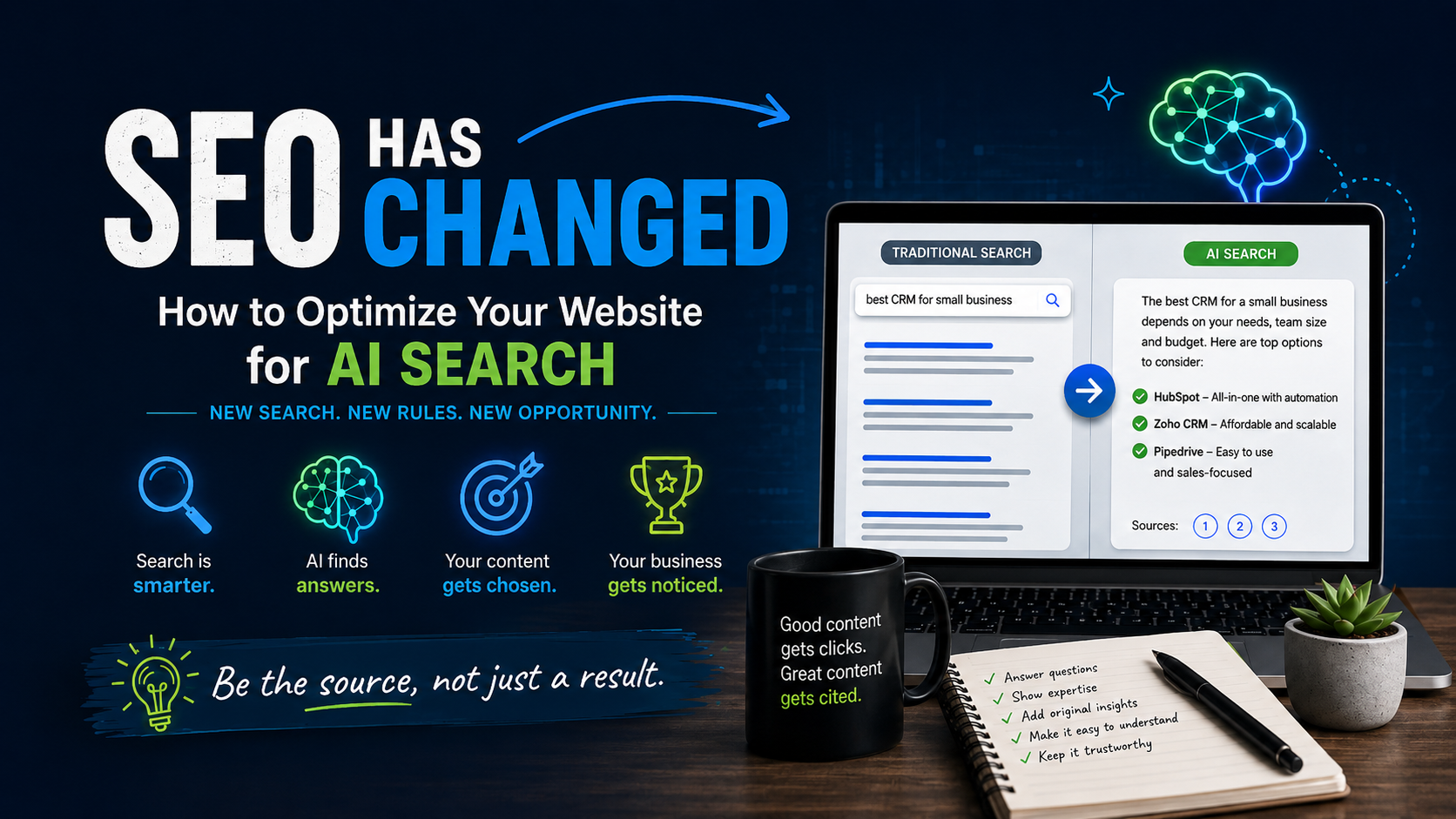
SEO is no longer just about getting your website to rank on Google. Businesses now need to create content that can also be discovered, understood and cited by AI-powered search tools such as Google AI Overviews, ChatGPT, Microsoft Copilot and Perplexity.
That doesn’t mean SEO is dead. Quite the opposite.
Google’s own guidance says traditional SEO fundamentals still apply to its generative AI search experiences. The difference is that marketers now have another objective: become a useful source for the answer, not just another link underneath it.
That changes how businesses should think about website content.
Key Takeaways
- Traditional SEO still matters, but businesses should also optimize content for AI-generated answers.
- AI search favors content that clearly answers specific questions and provides useful supporting information.
- Original data, firsthand experience and expert insights give AI systems a reason to cite your business instead of summarizing somebody else’s article.
- Businesses should build authority around topics, not produce hundreds of nearly identical pages for keyword variations.
- Technical SEO still matters because an AI search engine can’t recommend a webpage it can’t properly discover or access.
- There is no magical “AI SEO hack.” Google specifically says you do not need special AI markup,
llms.txtfiles or artificially “chunked” pages to appear in its generative search results.
In other words, you can put away the ceremonial AI SEO crystals.
There is actual work to do.
What Is AI Search Optimization?
AI search optimization is the process of making website content easy for AI-powered search systems to discover, understand, trust and use when answering a person’s question.
You may hear this described as Answer Engine Optimization (AEO), Generative Engine Optimization (GEO) or AI SEO.
Google’s position is refreshingly unexciting: it considers optimization for its generative AI features essentially an extension of SEO. Its AI-powered Search features continue to rely on Google’s existing Search ranking and quality systems.
The acronym may be new.
The need to publish useful information is not.
How Has Search Behavior Changed?
Traditional search often begins with a few words.
A prospective customer might type:
Atlanta wedding venues
With AI, the same person can ask:
What should I look for in an Atlanta wedding venue for 120 guests if I want an indoor ceremony, easy parking and a separate cocktail area?
That’s no longer just a keyword.
It’s practically a conversation with a very organized maid of honor.
AI-powered search systems can break complicated questions into related searches, gather information from different sources and generate a response. Google describes this process as query fan-out, where its generative Search features may issue multiple related searches across subtopics and data sources.
So a wedding venue could potentially appear as a source because its website provides excellent information about:
- wedding venue capacity
- indoor ceremony options
- parking
- cocktail-hour layouts
- venue pricing
- accessibility
- catering rules
- questions to ask before booking
The business doesn’t necessarily need one miraculous webpage ranking first for every version of “Atlanta wedding venue.”
It needs useful information across the questions customers actually ask.
Do Keywords Still Matter?
Yes. Keywords still matter, but marketers should think beyond exact keyword phrases and optimize around customer questions, related topics and buying decisions.
Google explicitly says foundational SEO remains important for its generative AI Search experiences.
So don’t fire your SEO person because somebody on LinkedIn announced that “keywords are dead” between posts about waking up at 4:17 a.m. and taking cold showers.
Instead, expand the strategy.
Imagine you operate a commercial HVAC company.
A traditional SEO strategy might target:
commercial HVAC maintenance
Keep that page.
But make it genuinely useful by answering questions such as:
How often should a commercial HVAC system be serviced?
Answer it directly.
Then explain how factors such as building size, equipment, climate and operating hours affect the schedule.
What does commercial HVAC preventive maintenance include?
Provide a useful list.
Explain what technicians actually inspect.
How much can neglected HVAC maintenance cost a business?
Use real examples or company data if you have it.
When should a commercial HVAC system be replaced instead of repaired?
Explain the decision criteria.
Can HVAC maintenance reduce energy costs?
Give the answer and cite credible research.
Suddenly, that company has information relevant to dozens of questions customers could ask Google, ChatGPT, Copilot or another AI service.
That is much more valuable than mentioning “commercial HVAC maintenance” 14 times and hoping the algorithm appreciates your persistence.
What Type of Content Is Most Likely to Be Useful to AI Search?
The strongest content generally does four things:
Answers the question.
Supports the answer.
Demonstrates expertise.
Adds something original.
A simple structure works remarkably well:
Question
Direct Answer
Evidence
Explanation
Example
Then move to the next logical customer question.
Consider this opening:
In today’s rapidly evolving marketplace, business owners face many challenges when attempting to navigate the complex world of commercial property maintenance.
That’s 22 words we’ve all read approximately 11 billion times.
Now try:
Commercial HVAC systems should generally receive scheduled preventive maintenance at least twice per year, although high-use systems and specialized equipment may require more frequent inspections.
The second version tells the reader something.
It also gives an AI system a clear passage to understand and potentially use.
Good AI optimization and good writing have something unexpectedly pleasant in common:
Both benefit from getting to the point.
Why Is Original Information Becoming More Valuable?
Because AI is already very good at generating generic information.
Ask an AI assistant:
What are five things I should consider when choosing a wedding venue?
It probably doesn’t need your 900-word blog post to figure out that couples care about price, capacity, location, catering and available dates.
So an article titled:
5 Things to Consider When Choosing a Wedding Venue
is competing with information AI can produce almost effortlessly.
Now consider:
What We Learned From Hosting 175 Weddings
or:
The Seven Wedding Expenses Couples Most Often Forget to Budget For
or:
The 10 Questions Wedding Planners Ask Us That Couples Usually Don’t
Those articles contain firsthand experience.
Google’s current guidance specifically recommends creating non-commodity content that offers original value, expertise and perspectives instead of simply reproducing information available everywhere else.
That creates a major opportunity for small and midsize businesses.
Your business knows things the internet doesn’t.
What Original Content Can a Business Create?
A surprising amount.
A Remodeling Company
A remodeling company could publish:
The Five Renovation Decisions Homeowners Most Often Change Mid-Project
What Actually Causes Kitchen Remodeling Delays
What We Learned From 100 Kitchen Renovations
The company has real project experience. Use it.
An Accounting Firm
An accounting firm could publish:
The Seven Bookkeeping Problems We Find Most Often When Companies Reach $2 Million in Revenue
or:
When Does a Small Business Need a Controller Instead of a Bookkeeper?
Include anonymized patterns from actual client work where appropriate.
An IT Services Company
Instead of another article called:
10 Cybersecurity Tips for Small Businesses
try:
The Security Problems We Found Most Often During 50 Small-Business IT Audits
That’s information worth citing.
A Commercial Cleaning Company
Instead of:
Benefits of Professional Office Cleaning
publish:
Where Office Cleaning Complaints Actually Come From: Lessons From 75 Facilities
You may discover the break room coffee machine has been quietly destroying civilization.
At least you’ll have original data.
A Restaurant or Caterer
Instead of:
How to Plan a Corporate Dinner
publish:
What 100 Corporate Event Planners Ordered, Changed and Forgot
Your own customer activity can become valuable content.
This is the shift marketers should understand:
The internet doesn’t need another summary of what everyone already knows.
AI particularly doesn’t.
Why Should Businesses Answer Specific Questions?
Because customers increasingly search conversationally.
A customer isn’t limited to typing:
best CRM
They can ask:
I run a 12-person consulting firm. We need a CRM that handles leads, email follow-up, appointment scheduling and automated text messages without adding another full-time employee. What should I look for?
That one question contains multiple information needs.
A CRM consultant or technology advisor could create content answering:
- What does a CRM actually automate?
- Which CRM features matter for consulting companies?
- Can a CRM automate text messages?
- Can a CRM replace administrative tasks?
- What does a small-business CRM cost?
- When is a business large enough to need a CRM?
- What integrations should a CRM have?
- What mistakes do companies make when implementing a CRM?
Now the website contains building blocks an AI system can use when researching complex questions.
Should Businesses Create Hundreds of AI-Optimized Pages?
No.
Creating a separate article for every imaginable variation of a question is not the strategy.
Google specifically cautions website owners against chasing AI visibility with low-value tactics and recommends concentrating on useful, original content and established SEO best practices. It also warns against scaled AI-generated content that adds little value.
Think topic authority, not content confetti.
Suppose a commercial security company wants to establish expertise around:
Commercial Security Systems
Its supporting content might cover:
- access control systems
- security cameras
- visitor management
- warehouse security
- office security
- retail loss prevention
- remote monitoring
- security system costs
- camera placement
- low-light surveillance
- multi-location security
- security system integrations
These pages should naturally connect to one another.
The goal is to make it obvious to customers and search systems:
These people know commercial security.
Not:
These people discovered ChatGPT on Tuesday and published 347 articles by Friday.
Can ChatGPT Find and Cite Business Websites?
Yes. Public websites can appear in ChatGPT search results when ChatGPT searches the web.
OpenAI operates a crawler called OAI-SearchBot for search-related discovery. OpenAI advises publishers who want their sites surfaced in ChatGPT search not to block OAI-SearchBot.
OpenAI also says businesses can identify referral traffic from ChatGPT because search-result links include the parameter utm_source=chatgpt.com.
That means businesses can begin measuring whether people are reaching their websites from ChatGPT instead of treating AI discovery as some mystical event occurring somewhere in the cloud.
What About Microsoft Copilot and Perplexity?
Other AI systems also use web search to ground answers.
Microsoft documents web grounding in Copilot products, where web searches can be generated from a person’s prompt and used to provide current information.
Perplexity’s search technology likewise retrieves current web results, and its AI products are designed to generate web-grounded answers using retrieved information.
The exact systems differ.
The marketing lesson doesn’t:
Useful, accessible, authoritative web content now has more places where it can be discovered.
Does Your Website Need Special AI Code?
Probably less than you’ve been told.
There are already consultants offering various technical shortcuts designed to make websites irresistible to AI.
Some are useful.
Some appear to have been developed in the prestigious Department of Things That Sound Technical Enough to Invoice For.
Google has specifically addressed several of these claims.
For Google Search, it says businesses do not need:
- special AI markup
- special machine-readable AI files
llms.txtfiles- artificial “chunking” of pages solely for AI
- manufactured online mentions designed to manipulate AI visibility
Google says standard crawlability, technical SEO, useful content and quality signals remain the foundation.
That doesn’t mean technical SEO is unimportant.
It means the fundamentals are still fundamentals.
What Technical SEO Still Matters for AI Search?
Your website should still make it easy for search systems to:
Find your pages.
Crawl them.
Understand their structure.
Identify your business.
Determine which page is the authoritative version.
Businesses should continue paying attention to:
- robots.txt
- XML sitemaps
- internal linking
- canonical tags
- page titles
- heading structure
- mobile usability
- page performance
- structured data where appropriate
- duplicate content
- indexing
- crawl accessibility
Google says those foundational SEO practices remain relevant to its generative Search features.
For ChatGPT visibility specifically, businesses should also confirm they aren’t accidentally blocking OAI-SearchBot if they want their public content available for ChatGPT search.
How Should Businesses Structure Content for AI Search?
There is no guaranteed formula that forces an AI service to quote your website.
If anyone guarantees that, you may wish to hold onto your wallet.
But a strong AI-friendly article structure looks like this:
1. Use One Clear Primary Topic
Don’t make the reader guess what the page is about.
2. Answer the Main Question Near the Top
Provide a concise explanation that could stand on its own.
3. Use Real Customer Questions as Headings
Especially questions customers ask during sales calls, consultations and support conversations.
4. Give Direct Answers First
Don’t make readers dig through six paragraphs before discovering whether the answer is yes or no.
5. Add Supporting Evidence
Include reputable third-party research where relevant.
6. Add Original Information
Customer patterns, survey results, internal data, experience, case studies and expert observations differentiate your page.
7. Identify the Expert
Include authors, credentials and relevant company expertise.
8. Cover the Topic Thoroughly
Answer the logical follow-up questions a prospective customer would ask.
9. Link Related Content
Help readers and search systems understand how your expertise fits together.
10. Keep the Information Current
Update statistics, recommendations and dated information when necessary.
Notice what is missing from that list:
“Mention your keyword 17 times.”
We have made some progress.
What Is the Best Content Formula for AI Search?
For most business websites, BetterBiz recommends thinking about content this way:
One important customer topic
Five to ten questions customers actually ask
Clear, direct answers
Supporting evidence
Firsthand expertise or original data
Strong company and author identification
Related content and internal links
Solid technical SEO
That approach serves three audiences simultaneously:
The customer.
Traditional search engines.
AI-powered search systems.
That’s a much better return on a piece of content than writing primarily for an algorithm.
Is SEO Being Replaced by AEO or GEO?
Not exactly.
You’ll hear plenty about:
SEO: Search Engine Optimization
AEO: Answer Engine Optimization
GEO: Generative Engine Optimization
There will undoubtedly be conferences, certifications and expensive PowerPoint decks devoted to determining which acronym we should all use.
Google’s answer is considerably simpler.
From Google’s perspective, optimizing for generative AI search is still fundamentally SEO because its generative experiences remain connected to its Search infrastructure and quality systems.
For business owners, the terminology is less important than understanding the change in behavior.
Traditional SEO asks:
How do we get our webpage into the search results?
AI search optimization adds:
How do we make our company’s expertise useful enough to become part of the answer?
You need both.
The Bottom Line: Don’t Abandon SEO. Expand It.
Customers aren’t going to stop using Google tomorrow.
They will continue clicking websites, maps, product listings, ads and traditional search results.
But search is becoming more conversational.
And as people become comfortable asking AI increasingly specific questions, the companies that win online will need websites capable of answering them.
That means producing fewer generic articles written primarily to satisfy a keyword.
It means producing more content based on:
real questions
real expertise
real experience
real data
clear answers
The future of search isn’t about tricking AI into mentioning your company.
It’s about giving AI, Google and your prospective customer the same reason to pay attention:
You actually know what you’re talking about.
That’s a marketing strategy that should survive the next algorithm update too.
Frequently Asked Questions About AI Search Optimization
What is AI search optimization?
AI search optimization is the practice of structuring and improving website content so AI-powered search systems can discover, understand and potentially use it when generating answers.
Is AI search optimization replacing traditional SEO?
No. Traditional SEO remains important. Google says foundational SEO practices continue to apply to its AI-powered Search features.
Can businesses guarantee that ChatGPT or Google AI will cite their website?
No. There is no legitimate method that guarantees a citation. Businesses can improve their chances by publishing accessible, authoritative, useful and original information.
Does a website need an llms.txt file to rank in Google AI results?
No. Google specifically states that it does not use llms.txt files for Google Search, including its generative AI features.
How can businesses track traffic from ChatGPT?
OpenAI says URLs from ChatGPT search include utm_source=chatgpt.com, allowing referral traffic to be identified in analytics platforms such as Google Analytics.
What content is best for AI search?
Content that directly answers customer questions, provides credible supporting information, demonstrates relevant expertise and adds original information or experience is a strong starting point. Google’s current generative Search guidance similarly emphasizes unique, valuable and non-commodity content.
About BetterBiz
BetterBiz helps businesses use AI, automation and emerging technology to improve marketing, customer engagement and business operations.
As AI changes how consumers discover companies, evaluate options and make purchasing decisions, BetterBiz helps organizations move beyond simply using AI tools and develop practical strategies for competing in an AI-driven marketplace.
Want to know whether your website is ready for AI search? BetterBiz can evaluate your current content, identify the questions your customers are asking and develop an AI search optimization strategy designed to make your expertise easier to find, understand and cite. Contact us today at info@betterbizgroup.com for more information.
