
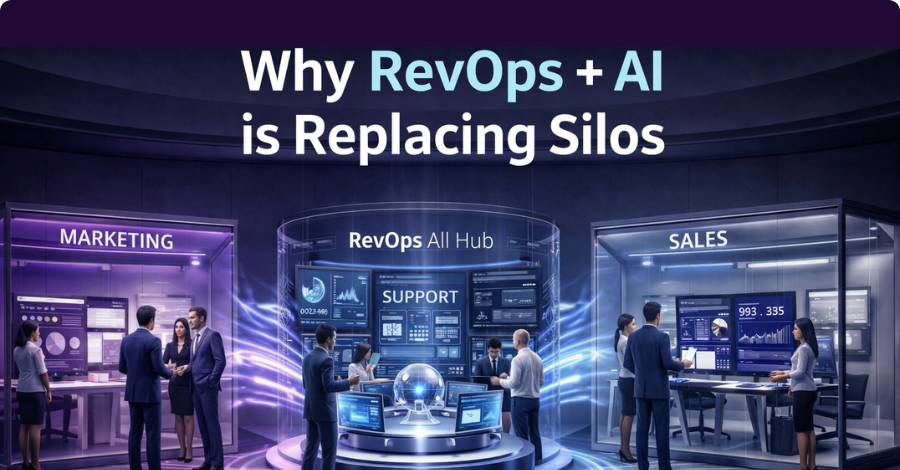
Marketing used to chase leads. Sales used to chase deals. Support used to chase problems. RevOps changes the game by aligning every customer-facing function around one goal: revenue. Add AI to the mix, and businesses can move faster, work smarter, and deliver a far better customer experience.
For years, companies treated marketing, sales, and support like separate kingdoms. Each team had its own tools, its own dashboards, and its own definition of success. Marketing celebrated lead volume. Sales focused on closed deals. Support tried to keep customers happy after the contract was signed.
It looked organized. It was not.
In reality, this traditional model often created disconnects that hurt growth. Leads fell through the cracks. Sales teams chased poor-fit prospects. Support teams handled frustrated customers without visibility into what had been promised during the sales process. Leadership ended up with fragmented data and a fuzzy picture of what was really driving revenue.
That is why RevOps, or Revenue Operations, is gaining momentum. RevOps brings marketing, sales, and customer support together under one operating model built around shared data, shared processes, and shared accountability. HubSpot defines RevOps as the people, processes, systems, and data that help businesses generate revenue more efficiently.
For BetterBiz readers, RevOps is not just a fresh label for old operations work. It is a smarter blueprint for modern growth.
Why the traditional silo model is breaking down
The old structure was built for a time when customer journeys were simpler. A prospect might see an ad, fill out a form, speak with a salesperson, and make a decision in a relatively clean sequence.
That is not how buyers behave now.
Today’s customer journey is messy. A prospect might discover a company through a social post, visit the website three times, download a guide, ignore emails, reply to a retargeting ad, ask a question through chat, book a call, go quiet for a week, come back for a demo, and then need support during onboarding before deciding whether to renew or expand.
Customers do not experience your business in departments. They experience one brand.
That is why silos are becoming more dangerous. When marketing, sales, and support work from disconnected systems, the customer experience becomes inconsistent, and revenue becomes harder to predict. Salesforce has emphasized that stronger alignment between sales and marketing is essential because both teams rely on the same customer insights to move accounts forward.
Support matters just as much. Companies that treat customer support or customer success as an afterthought miss a major revenue lever. Retention, expansion, referrals, and renewals all depend on what happens after the sale.
In other words, support does not sit outside the revenue engine. It is part of the engine.
What RevOps does differently
RevOps replaces departmental handoffs and conflicting metrics with one coordinated system for growth. Instead of asking whether marketing generated enough leads or whether support closed tickets fast enough, RevOps asks a more useful question: how well is the business attracting, converting, serving, and growing customer relationships?
That shift changes everything.
A RevOps model typically creates:
- a unified view of the customer
- shared funnel and lifecycle definitions
- cleaner handoffs between teams
- standardized data across platforms
- reporting that connects first touch to closed revenue and renewals
- stronger forecasting and performance visibility
This is what makes RevOps powerful. It forces the business to operate as one revenue team rather than three disconnected departments trying to hit separate goals.
Why AI makes RevOps even stronger
AI is not the strategy. It is the amplifier.
When businesses bolt AI onto siloed teams, they often speed up confusion. Marketing creates more automated outreach. Sales gets more summaries and prompts. Support deploys a chatbot. Everyone becomes more efficient at working separately.
That is not transformation. That is faster fragmentation.
AI works best when it sits inside a RevOps framework because RevOps gives AI what it needs to be useful: connected systems, cleaner data, and clear goals.
McKinsey has estimated that generative AI could deliver substantial productivity gains, with marketing and sales among the business functions with the largest economic potential. Microsoft research has also found notable productivity gains from generative AI in customer service and sales roles, where speed, consistency, and knowledge access matter most.
That maps perfectly to the RevOps model.
AI in marketing
Within RevOps, AI helps marketing do more than generate attention. It helps marketing generate better-fit opportunities.
AI can analyze engagement behavior, score leads, identify intent signals, enrich contact records, and personalize outreach based on real customer data. That means fewer vanity metrics and more focus on leads that are actually likely to convert.
AI in sales
For sales teams, AI can summarize calls, recommend next steps, draft emails, surface objections, and highlight deals at risk. Salesforce has reported that sales organizations increasingly view AI agents as critical to future growth.
Used properly, AI does not replace the rep. It removes friction so the rep can spend more time selling.
AI in support and customer success
This is where many companies still underestimate the opportunity.
AI can help customer support resolve routine requests faster, guide agents with suggested responses, summarize prior conversations, and make it easier for customers to self-serve. In a RevOps model, that matters because support is tied directly to retention and lifetime value, not just ticket volume.
AI in reporting and forecasting
RevOps lives or dies by visibility. AI helps leadership detect churn patterns, spot bottlenecks, identify pipeline risk, and surface expansion opportunities. It can turn disconnected data into actionable patterns faster than manual reporting ever could.
That makes AI especially valuable when it is helping the entire revenue engine, not just one isolated team.
Real-world examples of RevOps thinking in action
The best examples are not always companies that publicly call themselves RevOps organizations. They are companies using AI across multiple customer-facing functions in a coordinated way.
Lowe’s has deployed OpenAI-powered tools for both customers and store associates. Its customer-facing assistant helps shoppers discover products and plan projects, while its associate tool helps employees answer questions and provide better in-store support. That is a strong example of AI supporting both revenue generation and customer service in one connected experience.
Holland America Line built a virtual agent called Anna using Microsoft Copilot Studio to support customers and travel advisors on its website. The goal was not just to add a chatbot. It was to improve service, handle demand more efficiently, and create a better digital experience across the buying journey. That is classic RevOps thinking, even if nobody in the room wore a T-shirt that said “RevOps.”
Klarna showed how AI can influence both marketing and service operations. Reuters reported that Klarna used generative AI to reduce marketing production costs and also leaned heavily into AI for customer support. Later coverage suggested the company had to rebalance some of those efforts with more human support, which is an important reminder: AI works best when it strengthens an integrated operating model rather than trying to impersonate one.
What this means for SMBs
Some business owners hear the term RevOps and assume it is only relevant for giant companies with endless software budgets and an army of analysts. That is backwards.
Small and midsize businesses often have the most to gain because they cannot afford inefficiency.
They cannot afford leads sitting untouched for days.
They cannot afford sales reps calling the wrong prospects.
They cannot afford support issues that quietly turn into churn.
They cannot afford five disconnected platforms that all claim to be the source of truth.
RevOps helps lean teams operate with more discipline. AI helps them scale that discipline.
For SMBs, the winning formula is not buying the most tools. It is creating one smarter system where marketing, sales, and support all work from the same customer view and where AI improves execution across the whole customer lifecycle.
That is how a smaller company starts acting bigger without adding unnecessary complexity.
The BetterBiz perspective
At BetterBiz, we see RevOps and AI as a practical growth strategy, not a buzzword package dressed up for LinkedIn.
A strong RevOps model makes it possible to connect your CRM, lead capture, outreach, follow-up, appointment setting, support workflows, reporting, and customer communications into one coordinated machine. AI makes that machine faster and more responsive by helping qualify leads, automate conversations, route inquiries, support customers, and surface opportunities that would otherwise get missed.
That matters whether you are running a professional services firm, a growing local business, a multi-location operation, or an online company trying to turn more traffic into real revenue.
The businesses that win over the next few years will not necessarily be the ones with the biggest teams. They will be the ones with the clearest systems.
RevOps gives you the system. AI helps you run it at a higher level.
Final word
Traditional silos are expensive. They create blind spots, delays, and wasted effort. RevOps replaces that confusion with alignment. AI adds speed, intelligence, and scale.
That is why RevOps plus AI is not just a new way to organize teams. It is becoming the new operating model for growth.
And frankly, it is about time.
Build a Smarter Revenue Engine with BetterBiz
If your marketing, sales, and support systems still operate like separate departments passing problems to one another, BetterBiz can help you fix that. We help businesses unify lead capture, CRM, automation, follow-up, AI agents, and customer communications so revenue operations run as one connected system. Whether you need better lead qualification, faster response times, stronger support workflows, or a more intelligent growth engine overall, BetterBiz can help you put RevOps and AI to work in the real world.
Email us at info@betterbizgroup.com or visit BetterBiz AI for more information.
Sources: HubSpot, Salesforce, McKinsey, Microsoft, OpenAI, Microsoft Customer Stories, and Reuters.