
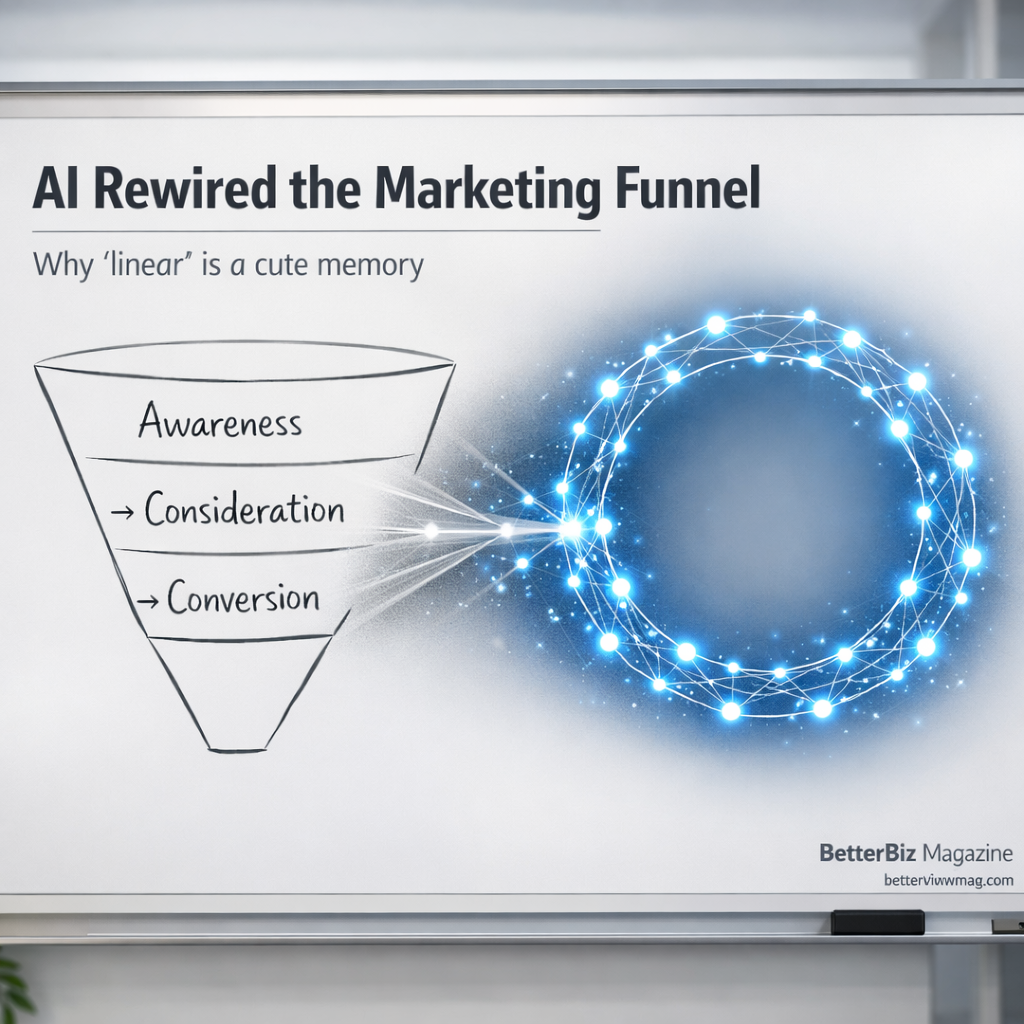
The traditional marketing funnel was built for a simpler world: you ran ads to create awareness, nurtured leads with email, then pushed for a sale. Neat. Linear. Easy to draw on a whiteboard.
AI showed up and basically said, “Cute diagram. Now meet reality.”
Buyers don’t march politely from Awareness → Consideration → Purchase. Google’s research describes the space between a trigger and a purchase as the “messy middle,” where people loop through exploration and evaluation until they’re ready to decide. AI doesn’t eliminate the messy middle—it weaponizes it in your favor by making every stage more personalized, faster, and (ideally) more helpful.
For small business owners—especially service providers—this is a big deal. You don’t need a 20-person marketing team anymore. You need a smarter system.
The Old Funnel vs. the AI Funnel
The old funnel (what we were told)
- Awareness: “Get your name out there.”
- Consideration: “Send content and follow up.”
- Conversion: “Close the deal.”
- Retention: “Do a newsletter and hope they remember you.”
The AI funnel (what’s actually happening)
AI turns the funnel into a responsive loop:
- Buyers jump stages.
- The “middle” is where you win or lose.
- Conversion often happens through conversations (chat/voice), not just forms.
- Retention is proactive, not reactive.
McKinsey notes that AI and generative AI help companies scale personalization—delivering more tailored experiences at a level humans can’t manually maintain. That’s the core shift: the funnel becomes adaptive.
What AI Changed at Each Stage (With SMB-Friendly Examples)
1) Awareness became “relevance at the moment of intent.”
Old-school awareness was basically: “Look at me.”
AI-era awareness is: “Here’s the exact answer you were looking for.”
Example: a local home services company (HVAC/plumbing/roofing)
Instead of running broad ads like “Best HVAC in Tampa!”:
- AI helps you identify the most common customer questions (from calls, chats, reviews)
- You publish hyper-relevant content: “5 signs your AC capacitor is failing in humid weather”
- Your ads and landing pages match the exact problem, not vague branding
This aligns with the bigger industry shift toward using first-party data (your leads, your inquiries, your interactions) as privacy changes limit third-party tracking. IAB has repeatedly highlighted the increasing importance of first-party data in a cookie-less world.
Translation: awareness is less “reach” and more “right message, right moment.”
2) Consideration became the main event (hello, messy middle)
Most prospects don’t say “no.” They say “not yet.” The messy middle is where they compare, hesitate, ask friends, read reviews, and doom-scroll your competitors.
Google’s messy middle model emphasizes that buyers cycle through exploration and evaluation before purchase. AI helps you shorten that loop.
Example: a service business (financial advisor / lawyer / marketing agency)
A prospect visits your site, checks pricing, then bounces.
Old funnel: you retarget them with “Book a call!” until they block you out of spite.
AI funnel:
- Your system detects intent (pricing page + case studies = high evaluation)
- It serves the next-best asset: “What to expect in the first 30 days” or a ROI calculator
- It triggers an automated follow-up tailored to their interest (not generic drip spam)
That’s not “nurturing.” That’s friction removal.
3) Conversion moved from “form fill” to “real-time conversation”
For small businesses, this is the most practical win: AI turns inbound interest into a booked appointment without you living on your phone.
Example: a dental practice
- Someone calls after hours
- A voice agent answers, gathers the basics (new patient? emergency? insurance?)
- It books an appointment or routes urgent cases properly
Example: a B2B consultant
- A lead submits a form
- An AI voice agent calls within 60 seconds, qualifies the lead, and books time on your calendar
This is exactly where BetterBiz fits: if you want to see what an AI Voice Agent experience looks like in the real world, you can test one at www.betterbizgroup.com.
4) Content stopped being a bottleneck (and became a testing engine)
The old funnel broke because content production couldn’t keep up. AI changes that by making content generation faster, and then the performance data decides what survives.
A real-world indicator of this shift: Reuters reported Mondelez (Oreo/Cadbury) using generative AI with Accenture to cut marketing content costs significantly and speed content creation, while still keeping human review in place.
SMB version: You don’t need 40 million dollars. You need a system that can:
- draft 10 ad variations
- produce 3 landing page angles
- generate 5 follow-up email themes
…and then let results pick the winners.
5) Retention shifted from “monthly newsletter” to “predict and prevent churn”
Retention used to be vibes. AI makes it measurable.
Salesforce’s State of Marketing emphasizes marketers investing in AI, unified data, and personalization at scale—often tied directly to loyalty and engagement outcomes.
Example: a fitness studio / membership business
- AI flags members likely to churn (fewer check-ins, no class bookings)
- It triggers a nudge that matches the customer: a beginner-friendly class, a short “restart” program, or a limited-time buddy pass
- Staff only steps in for high-risk, high-value members
Retention becomes proactive—less “win-back,” more “never lost them in the first place.”
The New Funnel Is a Loop (Here’s a Simple Model to Use)
If you’re a small business owner, don’t overcomplicate this. Think in five moves:
- Capture intent (calls, forms, search, DMs, inbound emails)
- Reduce uncertainty (answers, proof, pricing clarity, outcomes)
- Assist decisions (voice/chat qualification, scheduling, comparisons)
- Convert smoothly (book, buy, pay, onboard—without friction)
- Keep and grow (predict churn, personalize follow-ups, upsell smartly)
AI is the glue between these steps.
The Bottom Line for SMBs
AI didn’t kill the funnel. It exposed what the funnel always hid: buyers are unpredictable, impatient, and allergic to friction.
If you want a practical starting point:
- Fix your follow-up speed (minutes matter)
- Make your messaging answer real objections
- Let AI handle qualification and scheduling so your business doesn’t stall every time you’re busy actually doing the work
And if you want to experience the “conversion as conversation” shift firsthand, go test the AI Voice Agent at www.betterbizgroup.com.